
The housing market seems to be difficult for all involved: buyers sometimes struggle to find the best fit, and sellers sometimes struggle to find the right buyers. What are American homebuyers looking for?
Methodology
To understand what homebuyers today are actually looking for, we took a multi-pronged approach to analysis: examining search demand for various styles of architecture across the nation, analyzing Zillow availability for architectural styles, and surveying current homebuyers to get a more personal insight into current trends and preferences.
For the survey, we asked 661 homeowners and homebuyers about their preferences when it comes to buying a home. Ages ranged from 19-74 with an average age of 41; 55% were women, 43% men, and 2% identify as nonbinary.
For the search trends analysis and Zillow data, we analyzed 5,293 Google search terms between December 1, 2024 and November 30, 2025 across every state. Terms included major architectural styles as well as queries like “Tudor homes near me.”
After determining notable search trends by state, the architectural style most popular in each state was then searched for on Zillow to determine listing quantity as of January 2026. Population numbers to determine homes per capita were pulled from the U.S. Census Bureau. Publicly available Zillow data was provided by Zillow Group.
14% of Homebuyers Surveyed are Using AI to Find Homes
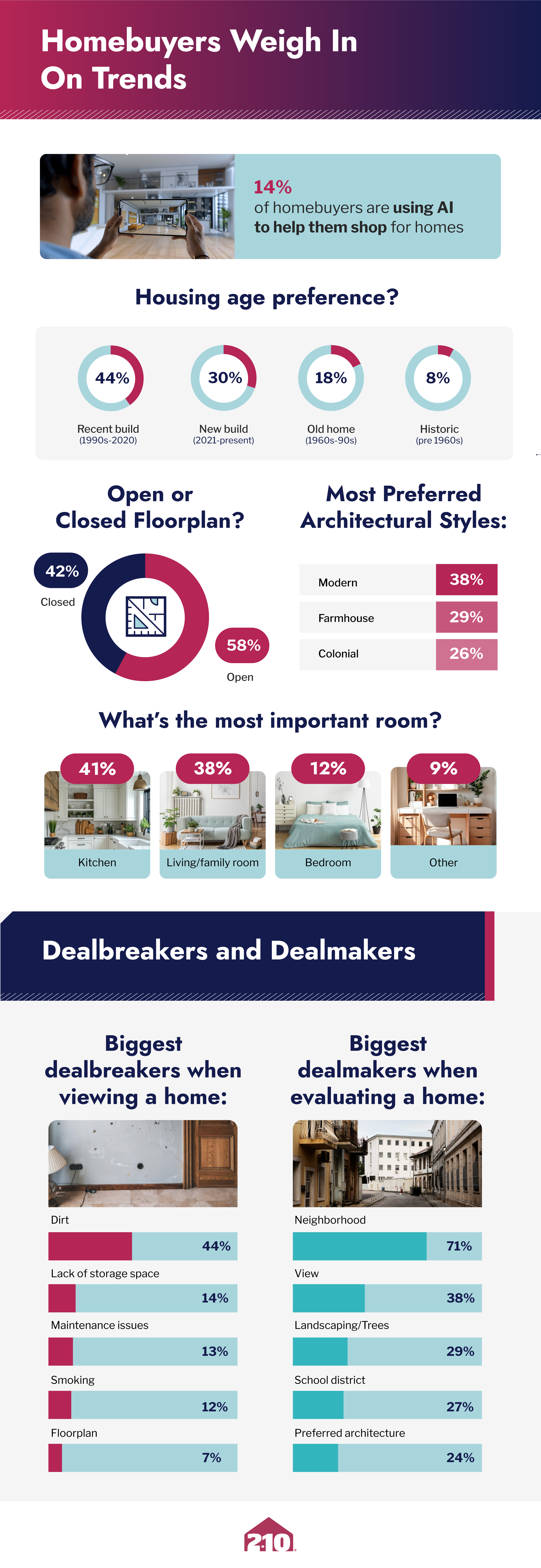
One notable trend? Technology: 14% of those we surveyed currently shopping for homes are using AI to assist them. That’s not the only new thing homebuyers surveyed are interested in, either: 74% are prioritizing new builds (2021-present) and recent builds (1990s-2020), with 30% particularly focusing on new build homes. Just 18% are interested in old homes, and 8% want historic homes.
With this embracing of the new comes continued enthusiasm for open floorplans: despite the return of the home office as a benefit post-pandemic, 58% still prefer open floorplan homes to those with more closed-off, segmented rooms.
We also asked what architectural styles respondents preferred; the top three were modern (38%), farmhouse (29%), and colonial (26%). As far as rooms go, the kitchen reigns supreme as the most important room in the home, with 41% of buyers prioritizing this space above all others. The living or family room follows closely behind at 38%, while bedrooms rank third at 12%. The way to a homeowner’s heart is clearly through their stomach!
First impressions matter significantly when touring potential homes, and certain factors can immediately eliminate a property from consideration. Dirt and cleanliness issues top the list of dealbreakers, cited by 44% of homebuyers surveyed as an instant turnoff. Lack of storage space concerns 14% of respondents, while maintenance issues and evidence of smoking each deter 13% and 12% of potential purchasers, respectively. Floorplan concerns round out the major dealbreakers at 7%, demonstrating that while layout matters, cleanliness and upkeep take precedence in initial evaluations.
Conversely, certain features can make a home irresistible to buyers. The surrounding neighborhood carries the most weight, with 71% of homebuyers surveyed identifying it as a primary dealmaker when evaluating properties. This overwhelming majority reinforces the real estate adage: location, location, location. Views command attention from 38% of respondents, while landscaping and mature trees appeal to 29%. School district quality influences 27% of buyers, and preferred architectural style matters to 24% of those searching for their ideal home.
The Most Sought-After Home Style in Every State
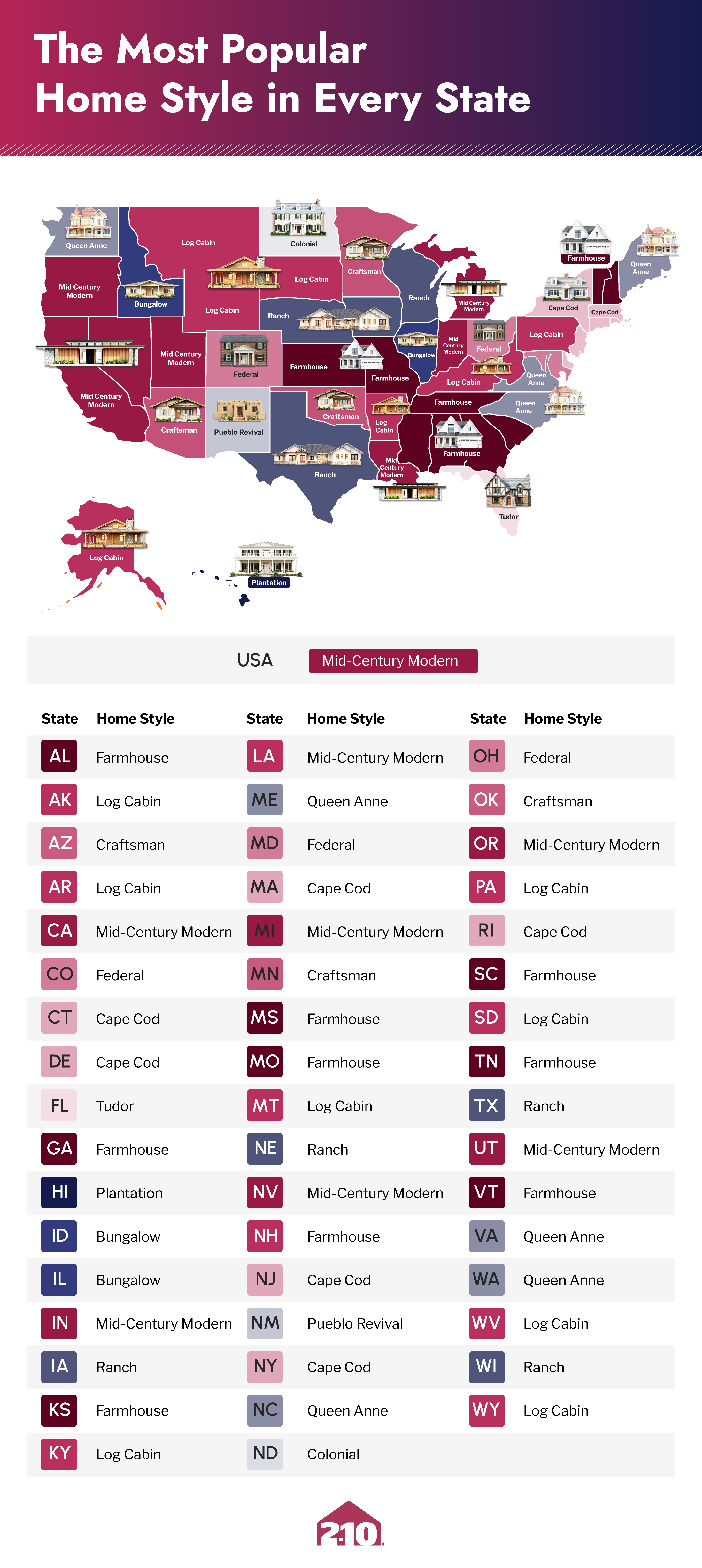
A key indicator of demand is seeing common searches on Google; in this section, we analyzed search trends nationwide to determine the most sought-after styles of homes.
Regional architectural preferences paint a diverse picture of American housing tastes. Mid-Century Modern homes claim the title of most popular style nationally and dominate searches in states including California, Indiana, Louisiana, Michigan, Nevada, Oregon, and Utah. This sleek, minimalist aesthetic resonates particularly strongly on the West Coast and in select Midwest markets.
The Farmhouse style maintains strong appeal across the heartland, ranking as the most sought-after style in Alabama, Georgia, Kansas, Mississippi, Missouri, New Hampshire, South Carolina, Tennessee, and Vermont. Log Cabins hold particular charm in Alaska, Arkansas, Kentucky, Montana, Pennsylvania, South Dakota, West Virginia, and Wyoming, reflecting preferences in mountainous and rural regions.
Cape Cod architecture dominates the Northeast corridor, claiming top spots in Connecticut, Delaware, Massachusetts, New Jersey, New York, and Rhode Island. The Ranch style, emblematic of post-war American suburbia, remains most popular in Iowa, Nebraska, Texas, and Wisconsin. More regionally specific styles include the Pueblo Revival architecture of New Mexico, Plantation homes in Hawaii, and Queen Anne Victorian designs favored in Maine, North Carolina, Virginia, and Washington state.
How Available are Popular Architectural Styles?
Availability of preferred architectural styles varies dramatically by region, creating opportunities for buyers willing to relocate. Nebraska leads the nation with 151.84 Ranch-style homes available per 100,000 residents, followed by Iowa at 146.14 Ranch homes per 100,000. Vermont offers exceptional Farmhouse inventory at 88.67 homes per 100,000, while Texas provides abundant Ranch options at 72.77 per 100,000. New Mexico's Pueblo Revival homes are available at 53.42 per 100,000, catering to buyers seeking this distinctive Southwestern aesthetic.
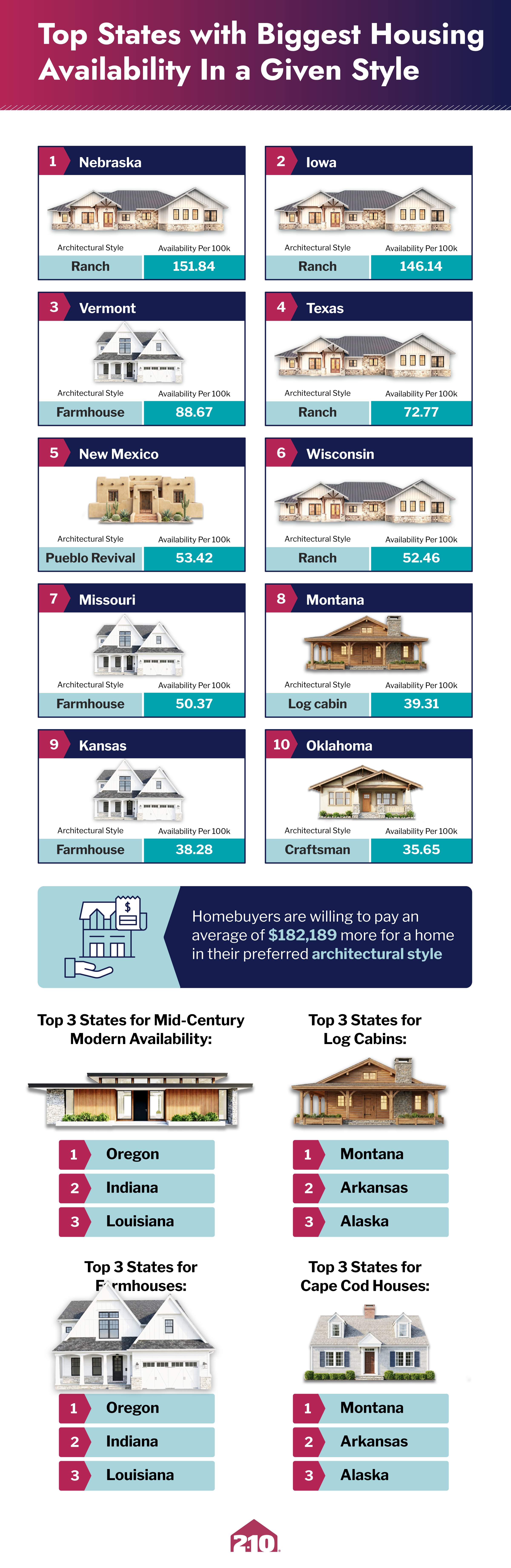
For Mid-Century Modern enthusiasts, Oregon, Indiana, and Louisiana offer the strongest inventory relative to population. Log Cabin seekers will find the best selection in Montana, Arkansas, and Alaska, where this rustic style aligns with local building traditions and lifestyle preferences. Farmhouse lovers should look to Vermont, Missouri, and Kansas for abundant options, while Cape Cod architecture is most readily available in Rhode Island, Connecticut, and Delaware.
The financial impact of architectural preference cannot be understated. Homebuyers demonstrate remarkable willingness to pay premium prices for their preferred style, with the average buyer surveyed ready to spend an additional $182,189 for a home that matches their architectural vision. This premium shows that aesthetic preferences play a major role in homebuying; architectural style is a reflection of lifestyle, value, and even identity.
Here’s a full summary of housing availability in a given style by state:
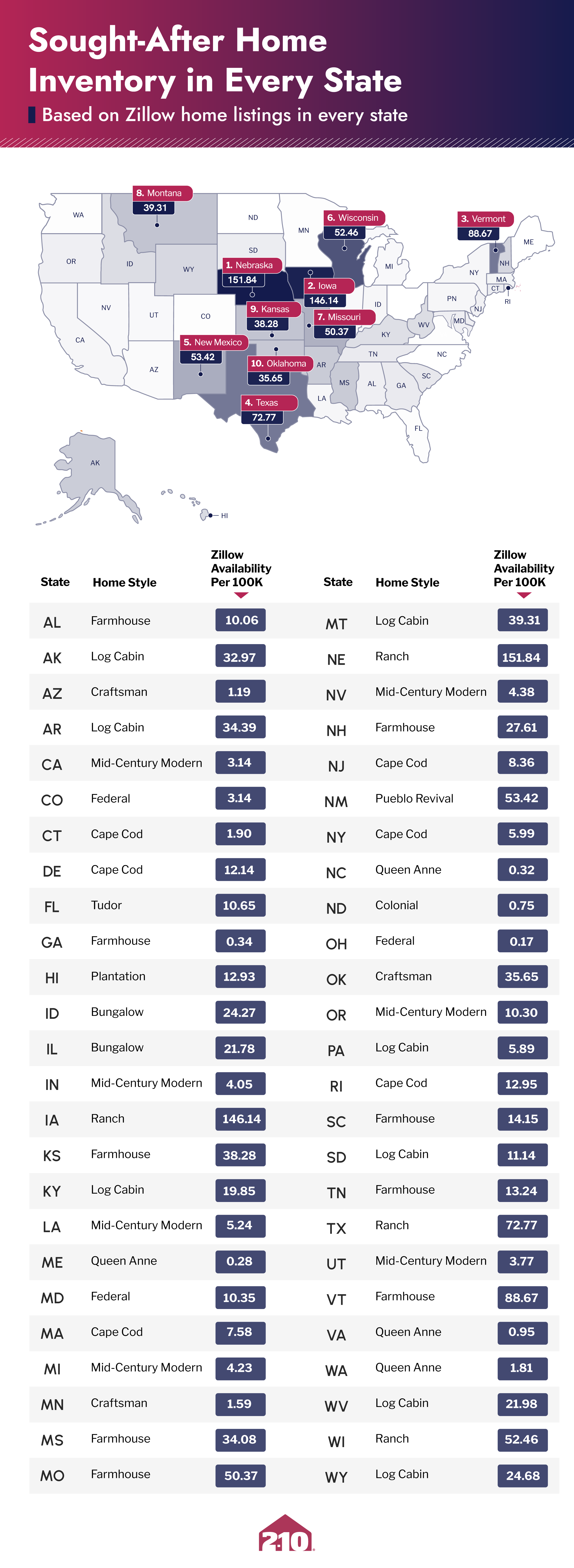
These preferences and priorities offer valuable insights for both buyers navigating today's competitive housing market and sellers preparing properties for sale. Understanding that cleanliness trumps nearly every other factor during showings, that neighborhood quality outweighs individual home features, and that architectural style commands significant premiums can inform smarter decisions on both sides of real estate transactions. Whether searching for a Mid-Century Modern gem in California or a classic Farmhouse in the Midwest, today's homebuyers demonstrate clear preferences that shape regional housing markets and drive purchasing decisions across the nation.
What this Means for Agents, Sellers, and Builders
Agents: Lead with Location
Since location is the top dealmaker, include that early in your listings. The more you can show off the location, the more persuasive your listing will be.
On tours, make the kitchen the hero of the tour, since it’s a top priority for buyers, and be sure to match your listings to the in-demand style language where applicable – are the people searching for MCM or mid-century modern?
Sellers: Keep it Pretty
Our survey results show that buyers like a home that is clean, well-maintained, and gives a great first impression. Be up-front about your home’s maintenance, and where you can, show off original charm with modern amenities. Additionally, don’t forget to market what you don’t have control over: neighborhood, views, and even school districts.
Builders: Spacious Kitchens are Key
It’s a great time to be a builder, especially as buyers lean increasingly into prioritizing new stock. Our survey shows that open floorplans and flexible spaces are big winners, but the kitchen is still king when it comes to home appeal: design kitchens for real life with plenty of storage. Most importantly: don’t make shortcuts, and ensure that you keep a high level of quality control to combat stigma around newer homes. Consider building homes in popular styles and incorporating that in your marketing; create additional trust from prospective buyers by using a builder’s warranty to help keep peace of mind as they settle into their new homes.
Consider a Home Warranty from 2-10, No Matter Your Style
Few things can crush the joy of finding a home that perfectly fits your architectural style than a breakdown to your furnace, fridge, or other major home system or appliance. With a 2-10 Home Warranty Service Plan, you can get the peace of mind that if part of a major system or appliance breaks down, you have a powerful solution that can help you protect your budget.
Plus, 2-10 offers two additional benefits that help homeowners overcome common challenges.
First, it gives you access to our qualified, independent Contractor Network. Moving to a new neighborhood can cause a lot of pain in researching and choosing a technician. With a 2-10 Home Warranty we’ve done that work for you. Reducing the time it takes to contact someone to address unexpected, covered breakdowns is a relief and can provide a sense of comfort.
Second, a 2-10 Home Warranty fixes covered parts of systems and appliances when they break down due to wear or tear. If 2-10 can’t repair the covered item, they’ll replace it.
*See the plan agreement for coverage details, including service fees, limitations and exclusions.
Coverage limits and charges for non-covered items may apply.
Fair Use
For media inquiries, reach out to media@digitalthirdcoast.net.
While citing this study, please attribute by linking to this page or https://www.2-10.com/.