Nearly all American homeowners plan to pick up a paintbrush, swap out a faucet, or knock down a wall this year. Home renovation trends in 2026 show a DIY-dominant culture shaped by tight budgets, social media inspiration, and a growing curiosity about AI-powered planning tools. At the same time, rising material costs exacerbated by tariff concerns are forcing many households to delay or rethink their plans.
Here's what the data shows.
Methodology
To understand how homeowners are approaching home improvement in 2026, we surveyed 1,003 U.S. homeowners in early 2026. Respondents ranged across income brackets, housing types, and geographic regions including urban, suburban, rural, and small towns. The survey covered project planning, budgeting, motivations, emotional experiences, and the role of emerging technology including AI tools. Ages ranged from 18 to 78 with an average age of 47; 49% were women, 50% men, and 1% nonbinary or chose not to disclose.
DIY in 2026: 94% are Planning Home Renovation Projects
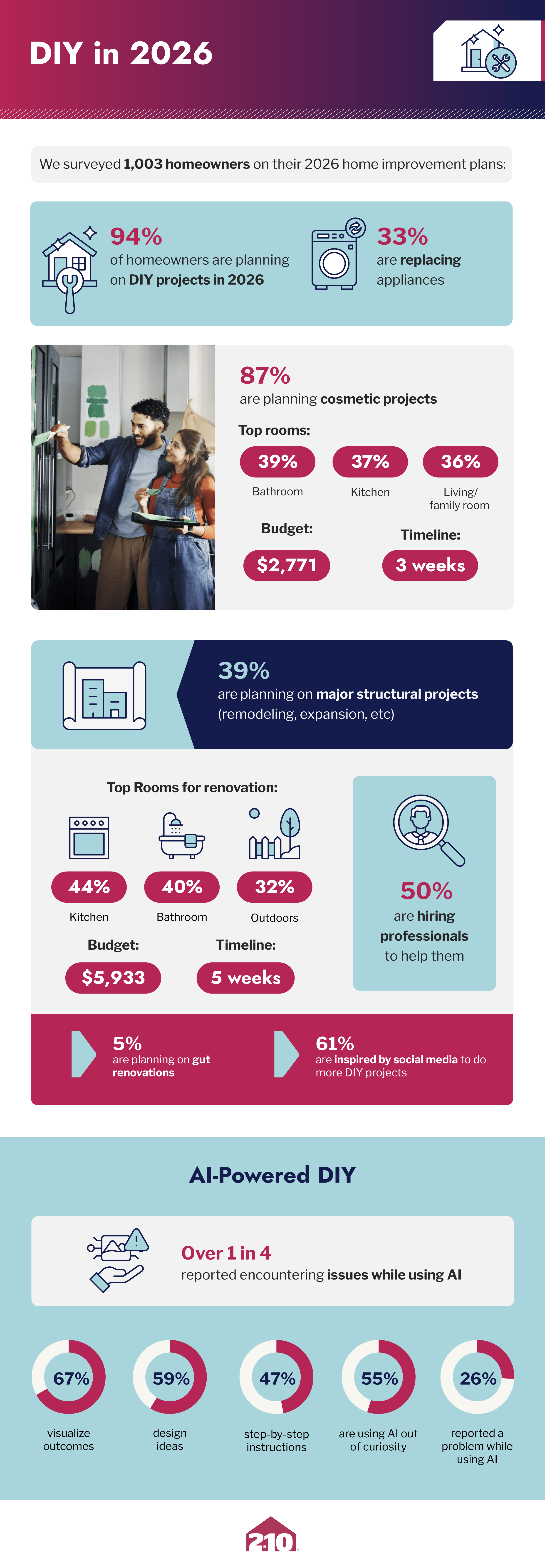
The 94% of homeowners planning DIY projects in 2026 signals one of the most active home improvement years on record. The vast majority (87%) are staying in cosmetic territory: fresh paint, new fixtures, updated décor. But the data also shows a meaningful portion of homeowners thinking bigger.
A third of surveyed homeowners (33%) plan to replace appliances, while 39% are eyeing major structural work: full remodels, expansions, or significant system overhauls. For those structural projects, the kitchen leads the way at 44%, followed by bathrooms at 40% and outdoor spaces at 32%.
For cosmetic projects, the bathroom tops the list at 39%, edging out kitchens (37%) and living or family rooms (36%), a slight reversal from years where kitchens dominated renovation conversation. At the far end of the spectrum, 5% of homeowners are planning full gut renovations.
Homeowners planning cosmetic improvements are budgeting an average of $2,771, with a projected timeline of three weeks. Those undertaking major structural projects are setting aside a significantly higher $5,933, with a five-week average timeline, and half of that group plans to hire at least some professional help.
The social media effect on home improvement is well documented, but the scale here is notable at 61% citing social media as a source of inspiration.
AI enters the tool belt
One of the more striking 2026 home renovation trends is the rise of AI as a planning companion. 26% of homeowners are now using AI tools to help with DIY projects, primarily to visualize outcomes (67%), generate design ideas (59%), and get step-by-step instructions (47%). The majority are exploring out of curiosity (55%), though 26% have already run into problems while using these tools, suggesting the technology is promising but still finding its footing in the home improvement context.
Home Renovation Costs in 2026: What's Driving the DIY Decision
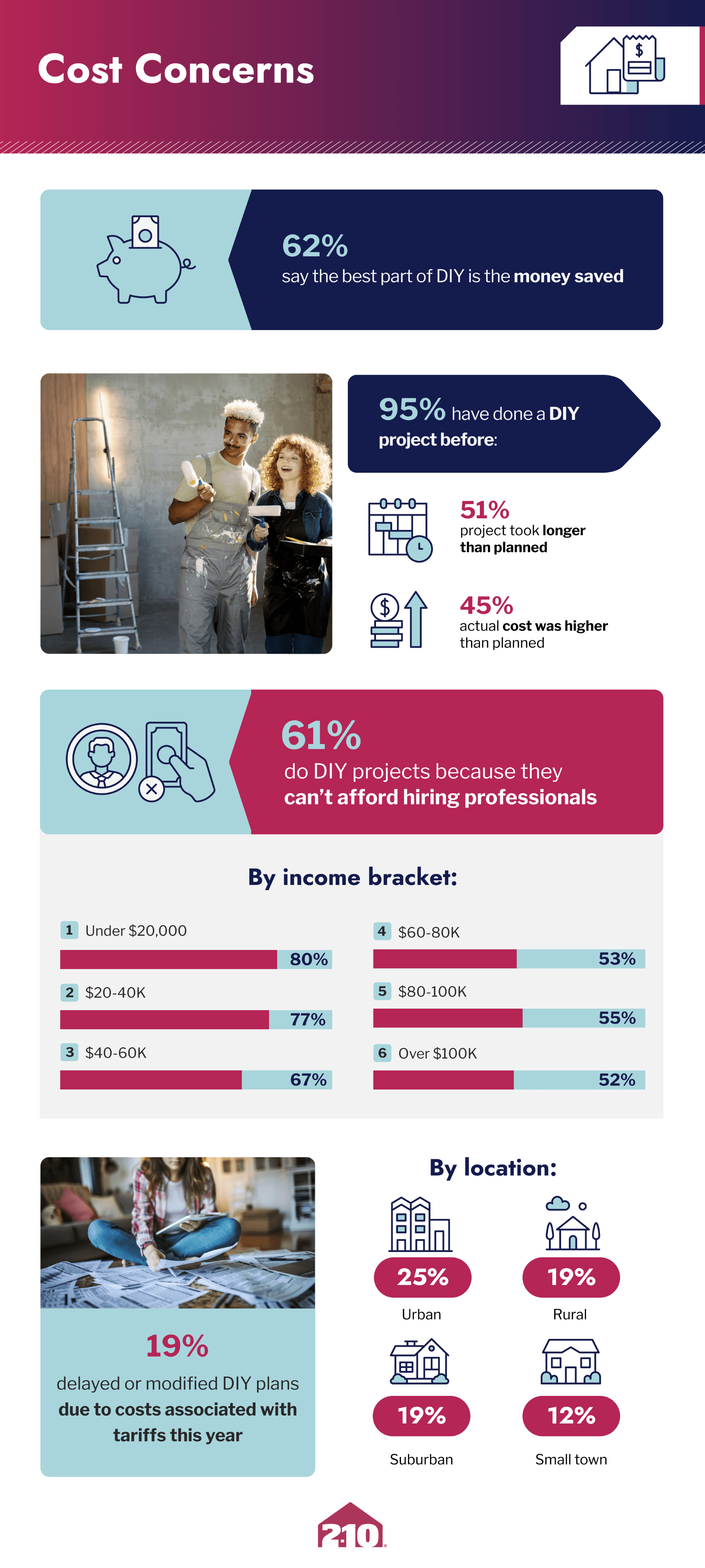
For most homeowners, the DIY decision is fundamentally a financial one. 62% of those surveyed say the best part of DIY is the money it saves, and 61% say they take on projects themselves because they simply can't afford to hire professionals, making cost the single biggest driver of DIY projects in 2026.
That calculus gets more complicated when actual project costs are tallied against expectations. Among homeowners who have completed a DIY project, 45% report the final cost came in higher than anticipated, while 51% say the project took longer than planned. These gaps between expectation and reality are a consistent issue for DIYers across all income levels.
The income breakdown
The financial pressure behind DIY decision-making is sharpest at lower income levels, but it doesn't disappear as income rises. Among homeowners earning under $20,000 annually, 80% of those surveyed cite the inability to afford professionals as a reason they DIY. That figure drops, but remains substantial, across every bracket, including 52% of homeowners earning over $100,000.
A new variable is complicating home renovation cost estimates in 2026: tariffs. 19% of surveyed homeowners delayed or modified their DIY plans this year due to cost increases they attribute to tariffs, a figure that climbs to 25% among urban homeowners and drops to 12% in small towns.
87% Say DIY Projects Build Their Confidence
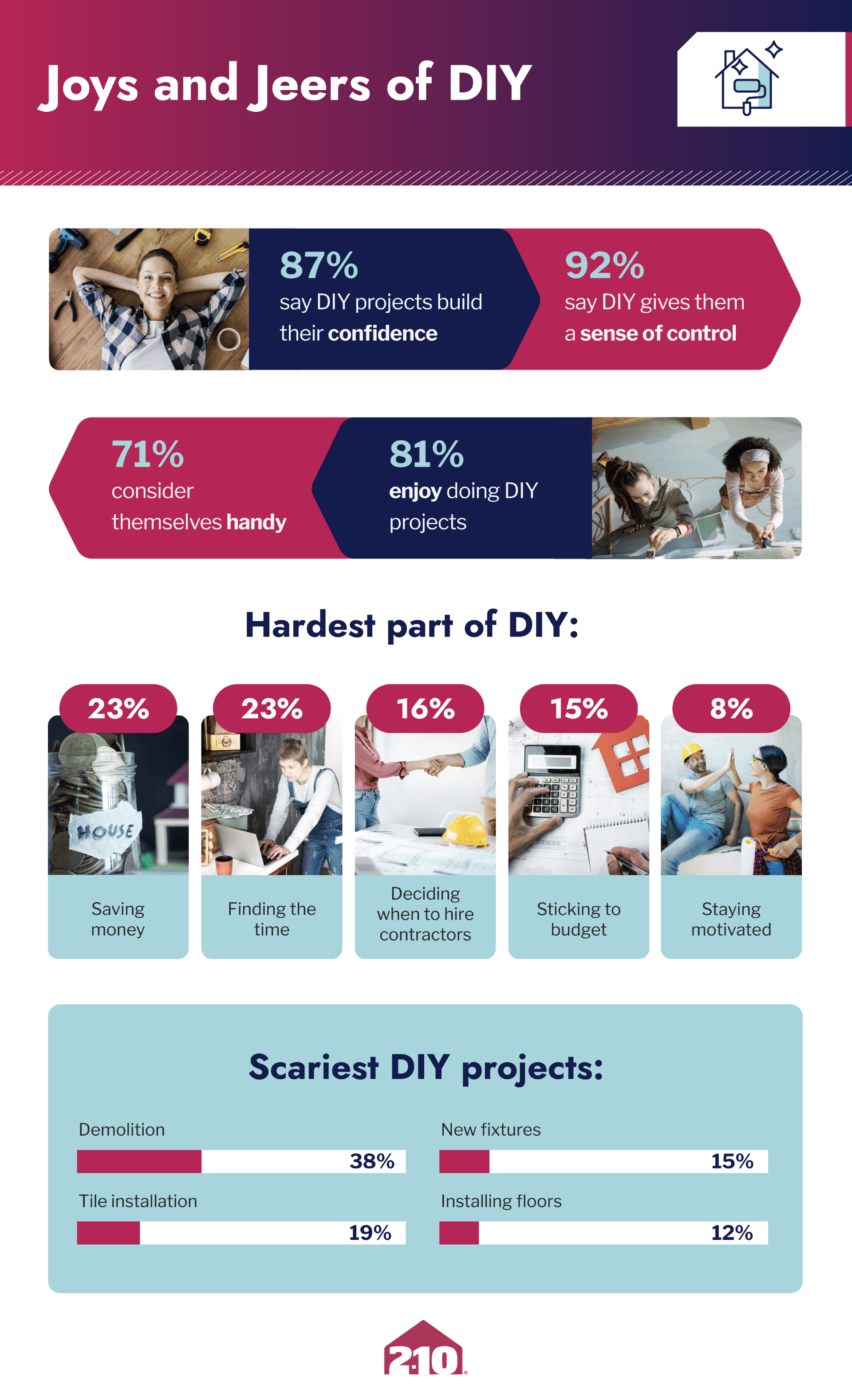
If cost is what drives homeowners toward DIY, emotional reward is what keeps them coming back. 92% say DIY gives them a sense of control over their homes and living spaces, a notably high figure that speaks to why home improvement has become a cultural touchstone well beyond simple property maintenance. 87% report that completing DIY projects builds their confidence, and 81% say they genuinely enjoy the work. 71% consider themselves handy, a self-assessment that likely influences which projects they're willing to take on without professional guidance.
Overall, the challenges homeowners most frequently cite aren't technical so much as logistical. Saving money and finding the time are tied as the hardest aspects of DIY (23% each), followed by knowing when to call a contractor (16%), staying on budget (15%), and maintaining motivation (8%).
That question of when to hire a professional is a meaningful friction point, and one that connects back to the broader home renovation cost conversation. Nearly two in five homeowners undertaking structural projects are already planning to bring in professional help, suggesting that even the most enthusiastic DIYers recognize limits.
When it comes to tasks homeowners find daunting, demolition tops the list at 38%, its combination of irreversibility and physical intensity making it uniquely anxiety-producing. Tile installation comes in second at 19%, followed by installing new fixtures (15%) and flooring (12%). These are all areas where small mistakes can become expensive to correct, which may explain both the hesitation and the growing interest in AI tools for pre-project visualization.
Frequently Asked Questions
What are the biggest home renovation trends for 2026?
The dominant trend is the near-universal adoption of DIY: 94% of surveyed homeowners plan at least one project in 2026. Within that, cosmetic upgrades in bathrooms, kitchens, and living rooms lead the way, while AI-assisted planning is emerging as a significant new behavior, with 26% of homeowners using AI tools to visualize or plan their projects.
How much should I budget for a home renovation in 2026?
Survey data shows homeowners are budgeting an average of $2,771 for cosmetic projects and $5,933 for major structural renovations. Notably, 45% of surveyed homeowners who have completed past projects say actual costs came in higher than expected so building a contingency into any estimate is strongly advisable.
Are tariffs affecting home renovation costs in 2026?
Yes. 19% of surveyed homeowners say they delayed or modified renovation plans this year due to cost increases they attribute to tariffs. The effect is most pronounced among urban homeowners (25%) and less prominent in small-town markets (12%).
Which rooms are homeowners most focused on renovating?
For cosmetic projects, bathrooms (39%), kitchens (37%), and living rooms (36%) are the top targets. For major structural renovations, kitchens lead at 44%, followed by bathrooms (40%) and outdoor spaces (32%).
Gen Zers are focusing on the bathroom (47%), outdoors (38%), and kitchen (34%); Millennials, Gen X, and Baby Boomers are all primarily focusing on the kitchen.
How are homeowners using AI for home improvement?
Among the 26% of surveyed homeowners currently using AI for DIY, the most common applications are visualizing project outcomes (67%), generating design ideas (59%), and getting step-by-step instructions (47%). Most are exploring out of curiosity, though a quarter have already encountered issues suggesting the tools are useful but still developing.
By generation, Gen Z and Millennials are leading the pack when it comes to embracing AI (28% apiece), primarily using it to visualize layouts, consider design ideas, and project planning.
No matter the project, we’re here to help
A home warranty can help with covered breakdowns of the most common and costly household headaches, like HVAC issues, appliances, roof leaks, plumbing issues, and more. Making sure your critical home systems are covered gives you peace of mind while you embark on your own DIY journey.
Media & Fair Use
When referencing this data and research, please attribute by linking to this study or 2-10.com. For media inquiries, contact media@digitalthirdcoast.net.